Introduction
What's common between your TV remote, the satellite beaming down your favorite channels, and your latest smart refrigerator? The answer is radio frequency (RF). All modern technologies use RF communication. This wireless connectivity is the backbone of almost all modern technologies, enabling devices to communicate over long distances without physical wires. Every RF communication system contains an RF module, a compact electronic component that acts as a wireless data transmission and reception gateway.
You must select the correct radio module for a particular application, as the selection impacts the performance and overall functionality of the device. The following content will take you through the critical factors influencing radio module selection, explore the various wireless technologies, and help you choose the perfect radio module for any application.
What factors must you consider before selecting a specific radio module?
It would be best if you considered the following factors before you decide on a particular RF module:
-
Range: This is the maximum distance a radio module can transmit and receive wireless signals. The range of the radio module is affected by the frequency. The lower the frequency, the greater the range. Antenna height is another factor that influences the range. Higher antenna placement translates into a longer range. Placing an antenna directly above ground reduces the range. In cases where there is a need for long distances concerning the antenna height, a two-ray ground model is a good option. The Friis model is helpful in some exceptional cases where the free space condition is fulfilled.
-
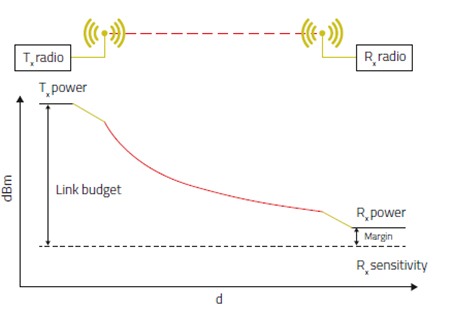
Link budget: The link budget is the sum of all the power gains and losses a signal experiences in a communication system, from a transmitter through a medium to the Receiver. PR = PT + GT - L + GR …………………………………………… (1) Where PR = Received Power (dBm) PT = Transmitted Power (dBm) GT = Transmitter antenna Gain (dB) GR = Receiver antenna Gain (dB) L = Free space path Loss (dB)
The above equation gives information about the Power received from the transmitter end after the attenuation of the transmitted signal due to propagation, antenna gains and feedline, and other losses and amplifications of the signal in the Receiver or any repeaters it passes. The higher the output power of the transmitter and the lower the receiver sensitivity, the higher the possible range of the transmission path.
Duty cycle: This defines the ratio of the time slot the transmitter sends out the signal of a given frequency and the time slot the transmitter stays quiet (not sending a signal) right after the transmission. It is commonly expressed as a percentage or a ratio. This constraint aims to ensure fair use of the frequency by multiple transmitters. It also ensures that a particular transmitter only blocks the frequency within a reasonable period.
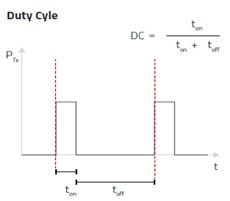
Figure 2: Duty cycle
- Polite spectrum access: Polite spectrum access covers a set of technology options, one being where the Receiver senses the channel before it transmits, and when a channel is found to be used, withdrawing the transmission until a later point in time. The duty cycle restrictions loosen when an application uses polite spectrum access. Polite spectrum access encompasses Listen Before Talk (LBT) and Adaptive Frequency Agility (AFA). LBT defines that a transmitter will continuously listen on a frequency given to detect that no other transmitter is sending out a signal. This cannot be eliminated but reduces the collision where two transmitters send on the same frequency simultaneously and jam the signal. AFA describes how different frequencies are used to transmit certain information.
- Integration of radio technology: Certification is a key factor to consider before you launch a product with integrated wireless technology. Integrated RF technology manufacturers must prove before the regulating authorities that their product conforms to regulations, laws, norms, and standards. These certifications include the CE mark for products distributed in the European market. After fulfilling the Radio Equipment Directive (RED), the manufacturer applies this mark. Wireless technology-based products in North America require FCC certification. For all other markets, national regulations apply. For example, a product introduction in Canada or Japan requires ISED or TELEC certification. Most national laws closely resemble CE or FCC. When it comes to integrating wireless technology, three options are available. The first option is flexible, where a device lacks a certified radio chip and antenna but is costly and challenging to integrate. The second is a device with a pluggable and easy-to-integrate external radio dongle, but less flexible, and the third option is a fully integrated low-design device with a certified radio module and antenna with low certification effort but reduced flexibility.
- Range: The Radio module should offer the desired range for communication between devices. This range may vary from 15 meters to more than 10 Kilometers.
- Data rate: Refers to the number of bits transmitted from one device to another across a network per second. Some modules offer higher data rates of more than 500 kbps for faster communication, whilst others prioritise energy efficiency and significantly lower data rates up to 1 kbps.
- Power consumption: Radio module selection is of prime importance. The choice of radio module for each protocol should be decided on whether the device is powered by battery or mains. Low-power modules play a significant role in extending the operational life of the device.
- Interfaces: The RF module connects to the device via an interface. An RF module may support several interfaces through which it can be controlled. These interfaces can be Smart Devices (Mobile, Tablet), PC, Server, etc., devices of their development, special communication interfaces (Wirepas, wM-Bus, CAN-Bus), and Mesh (Wirepas, Bluetooth® Mesh, Closed Mesh).
Why use a radio module?
RF-module provides potential savings in time and money compared to a single RF-IC. The inclusion of the needed circuitry saves the hardware development resources. An integrated antenna enables easy integration, even with minimal RF knowledge. The software integration, testing, and certification effort is minimised if the firmware is already available because the firmware is linked to module certification. The other advantages of RF modules are the lower development cost, high market success rate, and less time to market.
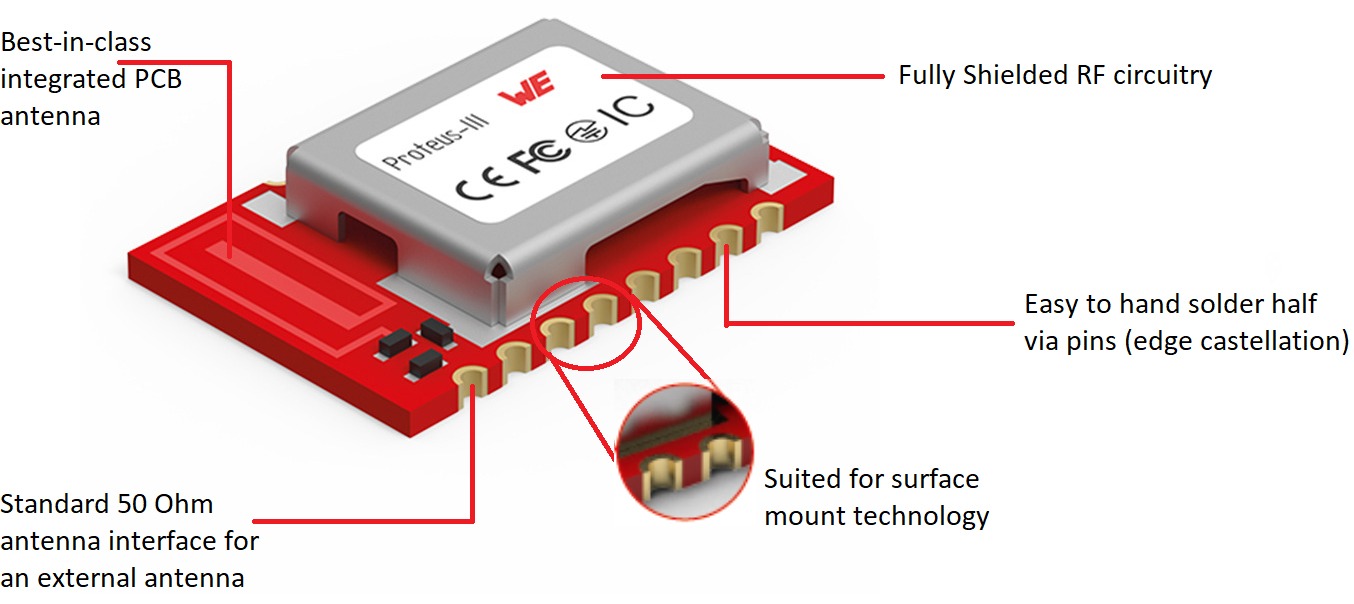
Figure 3: Radio module from Würth Elektronik
Würth Elektronik (WE) provides a complete solution with a wireless module that comes with a package of hardware (radio module), firmware (microcontroller & RF stack), and the needed software for evaluation.
Hardware: The WE radio module has an integrated antenna with a highly miniaturised design. It comes with powerful, ready-to-use RF-Chips. The design ideas are optimised by antenna simulation for the best performance. The Edge Castellation on PCB allows hand soldering in prototyping or small series production. The other key features are:
Speeds up time-to-market: WE Radio modules are fully developed, tested, and validated. These modules include all essential components and ensure reliable communication through standard protocols and proven RF performance. WE Radio modules provide faster development as it is possible to work with RF even if there are limited resources in manpower or knowledge.
One footprint for different frequencies: Most WE Radio modules offer the same footprint and form factor. These modules are easy to solder, even by hand, for smaller quantities in the prototype phase or small series.
One hardware platform: Würth Elektronik offers a high degree of freedom with one radio module footprint for many radio modules to expand the user's application with different radio protocols at any time without any layout changes. It has a proven hardware base that prevents the enormous costs of re-design in the future. For example, choose between a Bluetooth®, WirepasTM, proprietary radio module, or the combined variant of proprietary and Bluetooth®.
Integrated antenna matching: WE RF modules with an integrated antenna have a highly miniaturised design. The design ideas are optimised by antenna simulation for the best performance. The integrated antenna is perfectly matched to the evaluation board with a matching internal antenna. An external matching is optional for either matching any antenna to the module or re-matching the integrated antenna to different environmental conditions.
Firmware: Radio module Firmware from WE and radio stack WE-ProWare allow you to enter the wireless world immediately. It offers complete flexibility using different radio profiles and interfaces. The user need not write any software code; Instead, they can select additional options(profiles), which offer flexibility in network topology, data rate, throughput, range, and energy consumption. For a simple integration, WE also provide an Application Programming Interface (API) to communicate directly to the module and can be used with nearly every microcontroller, regardless of size. It also provides an interface for every application like UART, SPI, and I²C.
Software
Würth Elektronik provides plug-and-play PC-Software for easy evaluation, tests, and updates and mobile apps for easy assessment and testing. Design libraries are also offered for fast PCB design for Altium and Eagle. Würth also provides a Software Development Kit (C-Files) for comfortable coding of the HOST-controller System.
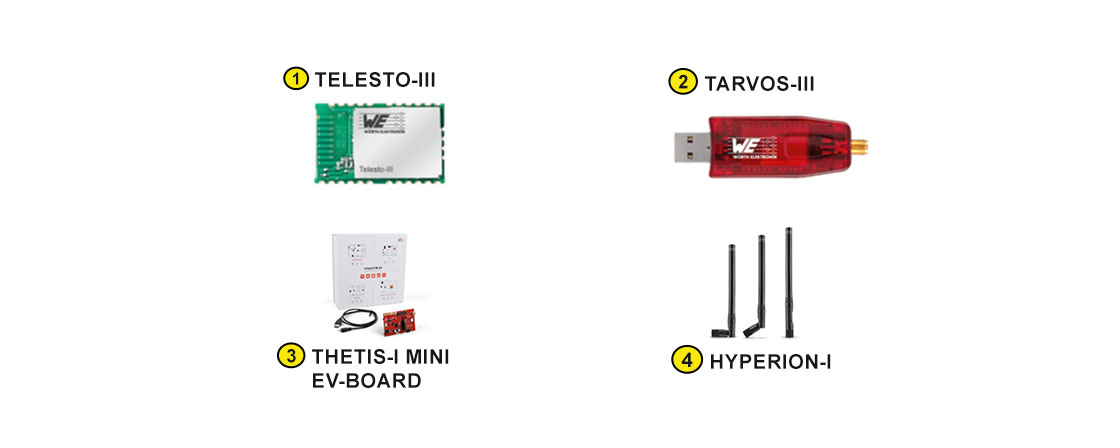
Telesto-III: A 915 MHz radio module with a range of up to 700 metres and RF output power of up to 15 dBm.
Tarvos-III: A USB radio stick with a transmission power of up to 25 mW and a frequency band of 868 MHz.It has an external SMA antenna connector and supports long-range mode.
Thetis-I Mini EV-Board is a simple evaluation board with the Wirepas Mesh module. It allows the user to develop hardware and software for the corresponding radio module.
Hyperion-I is a dipole antenna designed for 868 MHz applications in industries. It has a robust construction, provides a rotation of 360 degrees, and can be tilted up to 90 degrees.





技术


更多资源
计算器和换算表
选择指南和目录
基本学习模块
设计资源
工程词汇表
技术支持
Parts Finder Tools